You can spend hours trying to solve a production problem on your own, moving things around, changing sizes and convincing yourself that surely there's a clever way of making something work. Then you ring the printer and five minutes later they've suggested something, or sent you the PDF you needed that you just need to add the artwork to.
Printers don't possess some ancient knowledge passed down through generations of people slathered in ink. They've simply spent a lot of time making things. They've seen materials fold, crack, stretch, tear, absorb ink and behave in ways a perfectly rendered mock-up never will. They've seen it all.
With Europe's new Packaging and Packaging Waste Regulation beginning to change how businesses think about packaging, that relationship is going to become even more valuable.
Packaging can look deceptively simple when you're designing it on screen. Six sides, logo on the front, ingredients on the back, nice pretty colours and patterns. Then somebody has to make the thing.
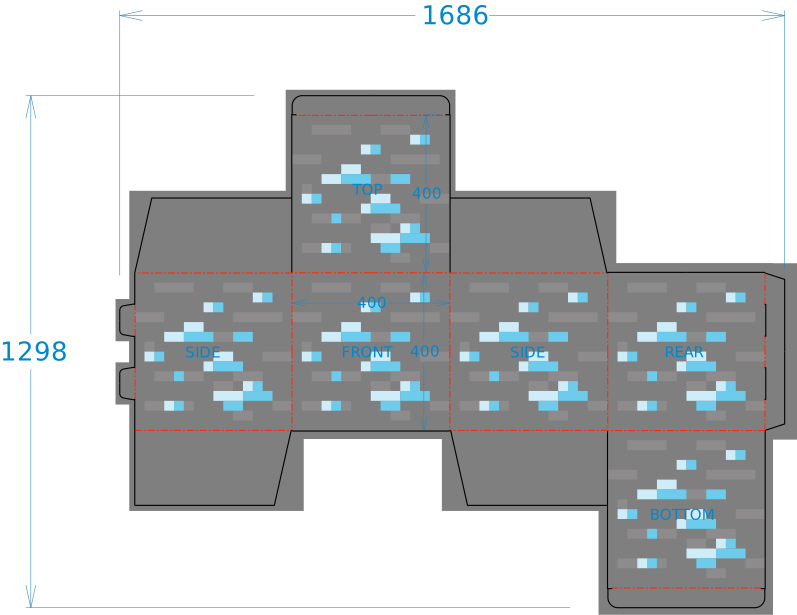
A carton begins life flat. It has to be printed, cut, creased, folded, joined, filled, closed, stacked, transported, opened, maybe more than once, and, increasingly importantly, dealt with when the person who bought it is finished with it.
That means packaging has its own vocabulary. Some homework for you.
A dieline, sometimes called a keyline, is essentially the flat plan of the package, showing where it will be cut, folded and assembled. Bleed is the extra artwork running beyond the cut edge so a tiny movement during trimming doesn't leave you with an unexpected white line. Creases tell the material where to fold. Tabs can tuck, lock or provide somewhere for adhesive to join the structure together. The substrate is simply the material you're printing onto.
Then there are tolerances, which are a useful reminder that the physical universe has never opened Illustrator. Machines move. Paper moves. Board has thickness. A fold takes up space. Things designed to precisely 0.001mm on a screen eventually have to survive reality.
You don't need to become an expert in any of this. But knowing the language makes it much easier to have the conversation. And that conversation needs to happen before the packaging has been designed.
If the process is: business briefs designer, designer creates packaging, printer receives finished artwork, we've left an enormous number of decisions until surprisingly late.
In the previous article, I asked a simple question about the EU's new packaging rules: how much packaging do we actually need?
The more practical question is: who should be answering that?
If the process is: business briefs designer, designer creates packaging, printer receives finished artwork, we've left an enormous number of decisions until surprisingly late.
Perhaps the box could be 5mm narrower. Perhaps two pieces could become one. Maybe a glued section could lock with a tab instead. Perhaps changing the dimensions slightly could fit another unit onto a sheet. Maybe the plastic window doesn't need to be there at all. Or perhaps it absolutely does because the product needs protection that the designer hadn't considered. These aren't decisions for one person.
The business understands the product, customer, price and commercial reality. The designer has to make the packaging communicate, get noticed, belong to the brand and work for the person buying it. The printer and manufacturer bring their own understanding of materials, machinery, construction and production.
The earlier they're talking, the more there is still time to change. By the time finished PDF artwork lands with the printer, a lot of those decisions have already been made.
This doesn't always require a miraculous new material made from seaweed and good intentions.
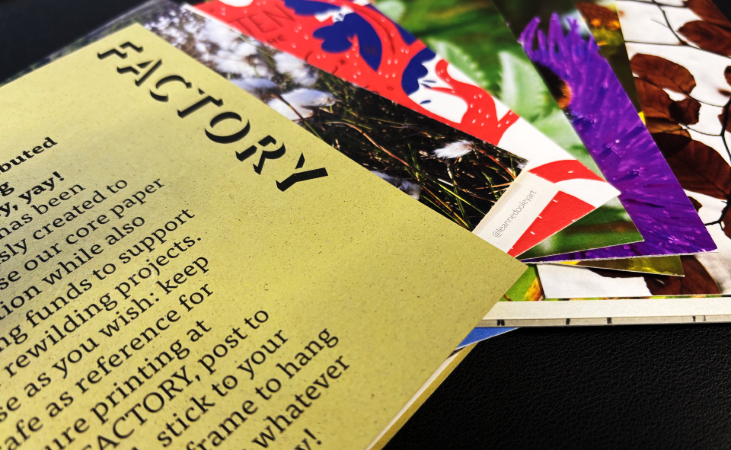
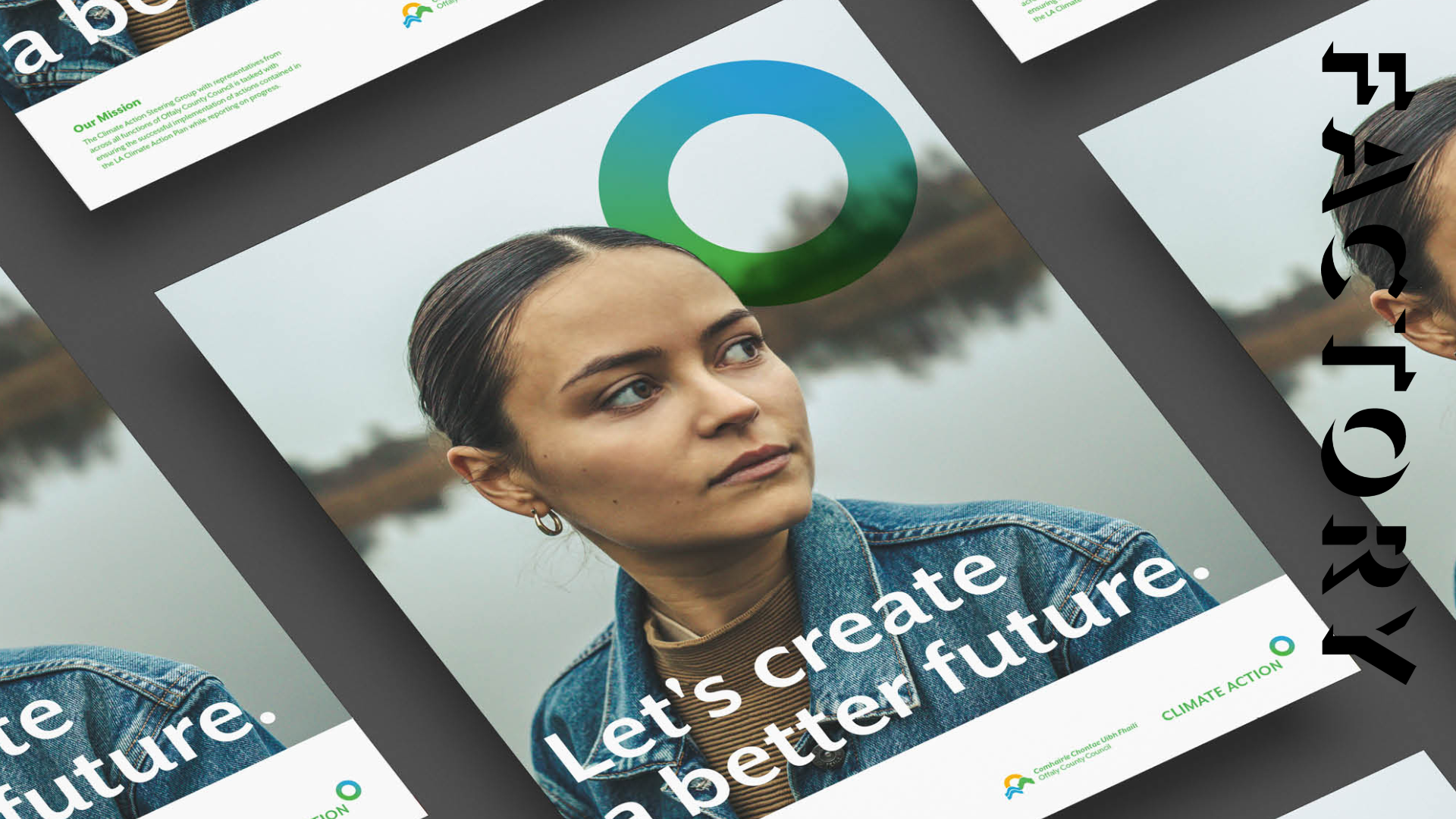
Irish print company The FACTORY published a wonderfully ordinary example of this in its research into reducing material waste. In its Zero Waste Design case study, it looked at a standard 85 × 55mm business card printed on an SRA3 sheet.
At that size, they could fit 21 cards on each sheet.
Then they changed the card to 80 × 50mm.
Five whole millimetres.
That relatively small change meant they could fit 36 cards on the same sheet. For a run of 250 cards, the number of sheets required fell from 12 to seven, which The FACTORY calculated as a 41.6 per cent reduction in material required.
Nothing about the finished object screams sustainable design. Nobody has put a green leaf on it. The customer doesn't have to plant the business card afterwards. It just uses less paper.
And that demonstrates something about the relationship between design and production. The dimensions of an object aren't only an aesthetic decision. They can determine how efficiently it can actually be manufactured.
Packaging gives us far more opportunities to ask the same sort of question.
Could a few millimetres mean another carton fits on a sheet? Could a structural change remove a component entirely? Could less material do exactly the same job?
Sometimes the environmentally better option isn't a new material. It's that maths you hated doing in school.
It's tempting to think that if a package is made from cardboard, the recycling question has been answered.
Unfortunately, cardboard can have quite a lot of friends attached to it.
Ink. Glue. Labels. Varnishes. Coatings. Laminates. Plastic windows. Barrier materials. Sleeves.
Under PPWR, recyclability is increasingly about the packaging as a whole. The EU's design-for-recycling criteria are intended to consider all packaging components and whether the resulting waste can actually be separated, sorted and recycled into useful secondary material.
That doesn't mean ink is bad or lamination is banned.
A coating might be protecting food from moisture. A barrier might be necessary for hygiene. An adhesive might be the most efficient way of constructing the pack. The European paper industry's own recyclability guidance acknowledges that paper packaging sometimes needs coatings, laminates and other treatments to perform properly, even though those additions can make recycling more challenging.
The question isn't necessarily can we remove it? It's what is it doing?
If a laminate is protecting the product, that's one conversation. If it's there because somebody likes the way it feels, that's another.
If a plastic window helps someone understand what they're buying, perhaps it earns its place. If it's there because every previous version had one, perhaps it deserves another look. If two materials are being joined together, can they be separated afterwards?
And if you don't know the answer, that's probably a good moment to ring somebody who might.
You know who I'm going to suggest.
Now, there's a danger of making the printer sound like some sort of production oracle at this point. They aren't.
A printer might know that a particular stock won't fold cleanly, or that changing a dimension could dramatically improve the efficiency of a print run. That doesn't mean they know how your brand should communicate or what will make somebody notice your product beside twenty competitors.
Likewise, a designer shouldn't be expected to know the precise behaviour of every board, adhesive, coating, press and recycling process.
Sometimes the printer will suggest the solution. Sometimes the designer will question something everybody else has accepted. Sometimes the manufacturer knows the product requires something neither has considered. Sometimes the business knows customers hate opening the existing package.
Good collaboration isn't everyone staying in their lane.
It's everyone knowing enough about the other lanes to ask better questions and come up with better solutions.
Packaging still has to communicate what something is. It still has to get noticed. It has to feel appropriate to the product and its price. It has to belong to the brand. It has to work in someone's hand, survive its journey through warehouses and delivery vans and, occasionally, create a little moment when somebody opens it.
As I wrote in the previous article, PPWR introduces new constraints around how we do that.
That doesn't mean the answer is to remove everything interesting until every shelf in Europe becomes a wall of worthy brown cardboard. It means the decisions need to become better informed.
The designer doesn't need to become a printer. The printer doesn't need to become a brand strategist. And the business doesn't need to become a recycling expert, but it does need to understand what happens to its packaging once it's finished with it.
It needs to understand enough to ask the right questions, involve the right people and make informed decisions. Which means they probably need to talk to each other.
One of the most useful lessons I learned early as a designer was to make friends with your printer. Not because they'll tell you what to design, but because they'll often help you see a solution you wouldn't have reached on your own.
With packaging about to carry a few more constraints, that's probably a useful friendship to have.